Archive for the ‘Uncategorized’ category

Body of Play – 2

March 2, 2011

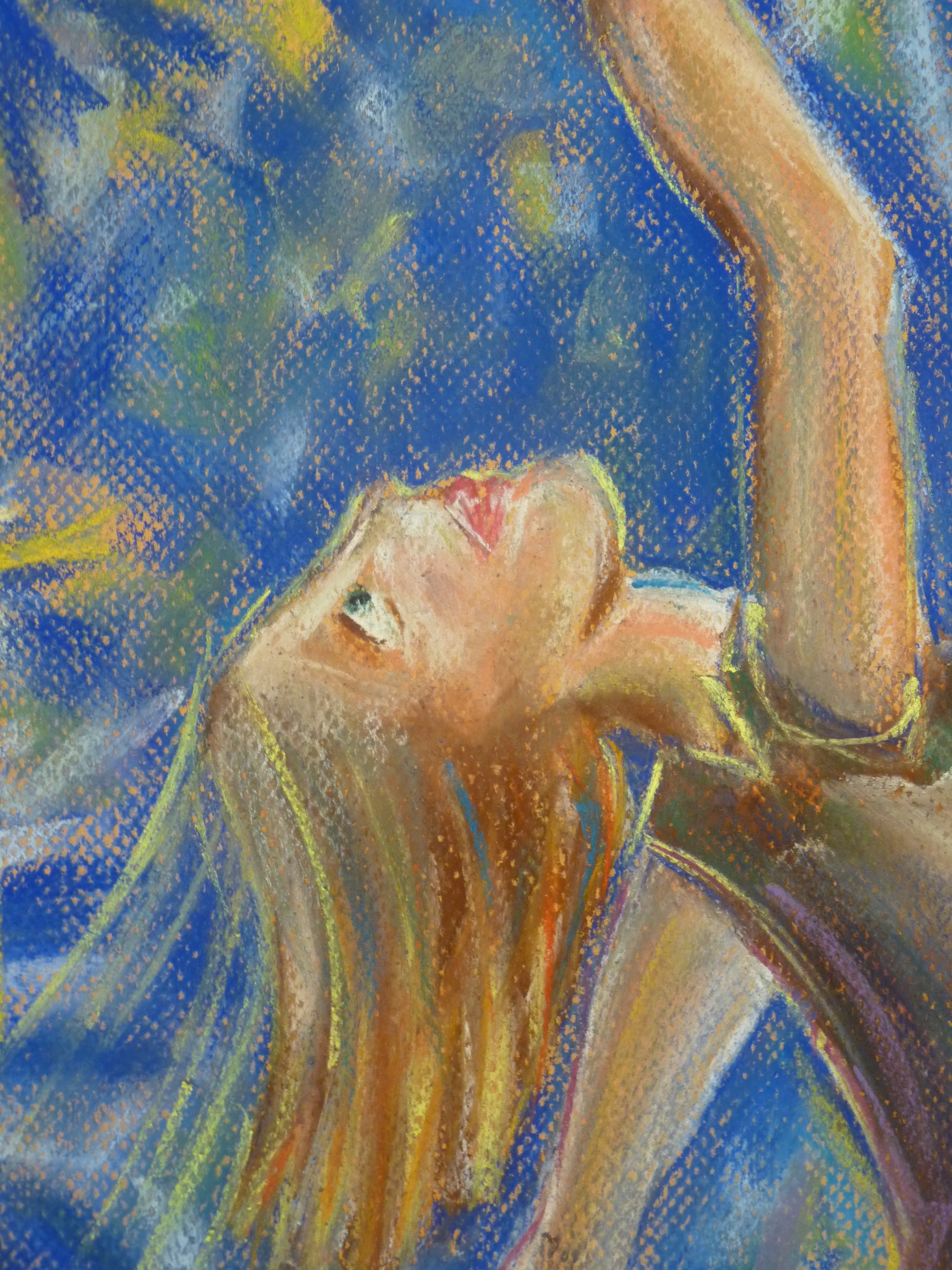
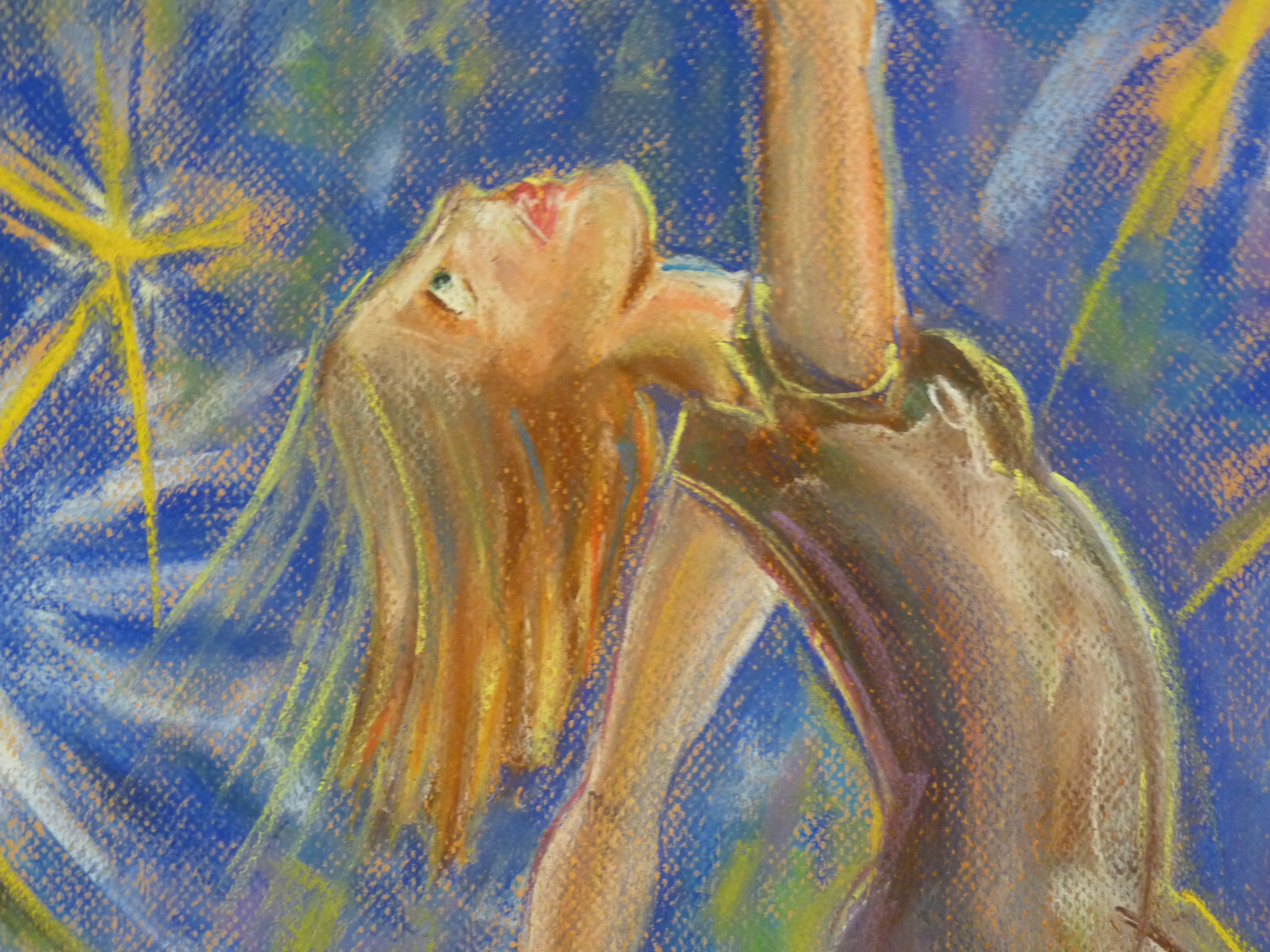
reach - pastel Books, images, dreams, affirming messages are coming into my life, seemingly randomly, synchronistically.  These threads are being woven, are still loose and unfinished…this writing will leap from idea to experience to image… more is being given than I can yet know.

While waiting at the mall for my teenage daughter and friend to be done shopping, I wander the bookstore, come upon the book Play:  How it Shapes the Brain, Opens the Imagination, and Invigorates the Soul by Stuart Brown, MD. (2009) In this book, I read “Properties of Play:  Apparently purposeless (done for its own sake), Voluntary, Inherent attraction, Freedom from time, Diminished consciousness of self, Improvisational potential, Desire to continue. (pg. 17)  And later, in the same book, in a discussion with biologist Bob Fagan about why animals play:  “In  a world continuously presenting unique challenges and ambiguity, play prepares these bears for an evolving planet.” (pg. 29)

Like the bears, I am responding to the challenges and ambiguity of ever evolving life, by playing.

In my therapy practice, I am developing a program for trauma survivors with eating disorders. In Peter Levine’s book In an Unspoken Voice: How the Body Releases Trauma and Restores Goodness, I underline page after page with nuanced and inspiring statements about how healing from trauma needs to be approached “from the body up.”

I am drawing an image from a favorite folk tale about a girl who dreams of touching the stars.  I draw her over and over, not satisfied.  I need to keep drawing the arc of her reach so that I can feel my own body reaching for my dreams. I make a chalk version of this image.  Still frustrated, I use the camera to look at the chalk drawing from different angles, different cropped views, trying to see what is essential in this image of reaching for the stars.
Reach For

The morning before a day of play, I have a dream. I am asking an artist this question: How do I change direction in my art making  – when I know I am stuck in a rut – without shutting down my process through being overly critical of myself?  I wake before the artist answers.

Instead of drawing more dancing women, I start the day talking to myself in the shower.  “Body of play, body of work, body politic, body image, embodied, disembodied, corporate, corporeal, body of Christ, anybody, somebody, nobody.”

I dance in the shower.  An idea for a new direction comes to me. Draw lifesize dancing women.

But not yet, something says, not yet.  I need a break from drawing. Don’t rush this process – don’t force.  I write in my journal.  I doodle. I read. Books that inspired me years ago recross my path.
Doodle 1

From The Reenchantment of Art, by Suzi Gablik:  “The emerging new paradigm reflects a will to participate socially: a central aspect of new paradigm thinking involves a significant shift from objects to relationships. It is what the philospoher David Michael Levin describes as ‘the rooting of vision in the ground of our needs; the need for openness, the need for contact, the need for wholeness.'” (pg. 7)

From Studio Art Therapy: Cultivating the Artist Identity Within the Art Therapist, by Catherine Moon:  “A relational aesthetic is characterized by a concern for the capacity of art to promote healthy interactions within and among people and the created world.” (pg. 140)

A few days later, a free evening, unexpectedly.  A friend has introduced me to the music of Baaba Maal. I down-load some of his music and it makes me want to dance.  So I dance.  Years ago, as a kid with childhood rheumatoid, I danced to 45’s, hit singles from the early 1970’s.  Hours of dancing.  Later, in college, in the early 80’s, I was in the middle of the crowd at every dance party. When my daughter was little, a toddler, we danced, sometimes both of us naked in our living room. I wasn’t going to let myself get too busy, too grown-up to stop dancing.  But the times between dancing get further and further apart.

It feels so good to be dancing again.  Why have I waited so long to let myself do this?  I close my eyes and move.  I start to feel it happening – this shift I have felt since I was that young girl dealing with an illness that scared me.  The way the music becomes part of my body.  The way my body becomes reverent while dancing.  Elated and reverent.  And the way I almost see – definitely feel – other dancers, ancient ones, a ring of them encircling me, protecting me, when I keep dancing, keep my eyes closed, go deep enough into the music.  The guardians of the dance.

I realize I want to make something to honor them.
Doodle 2

Doodle 2

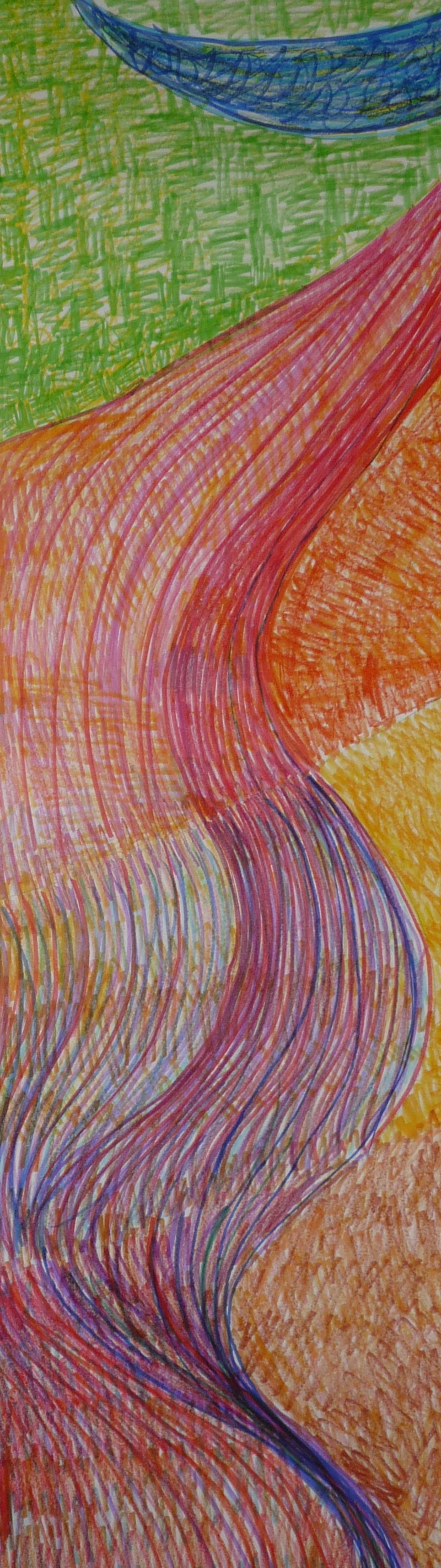
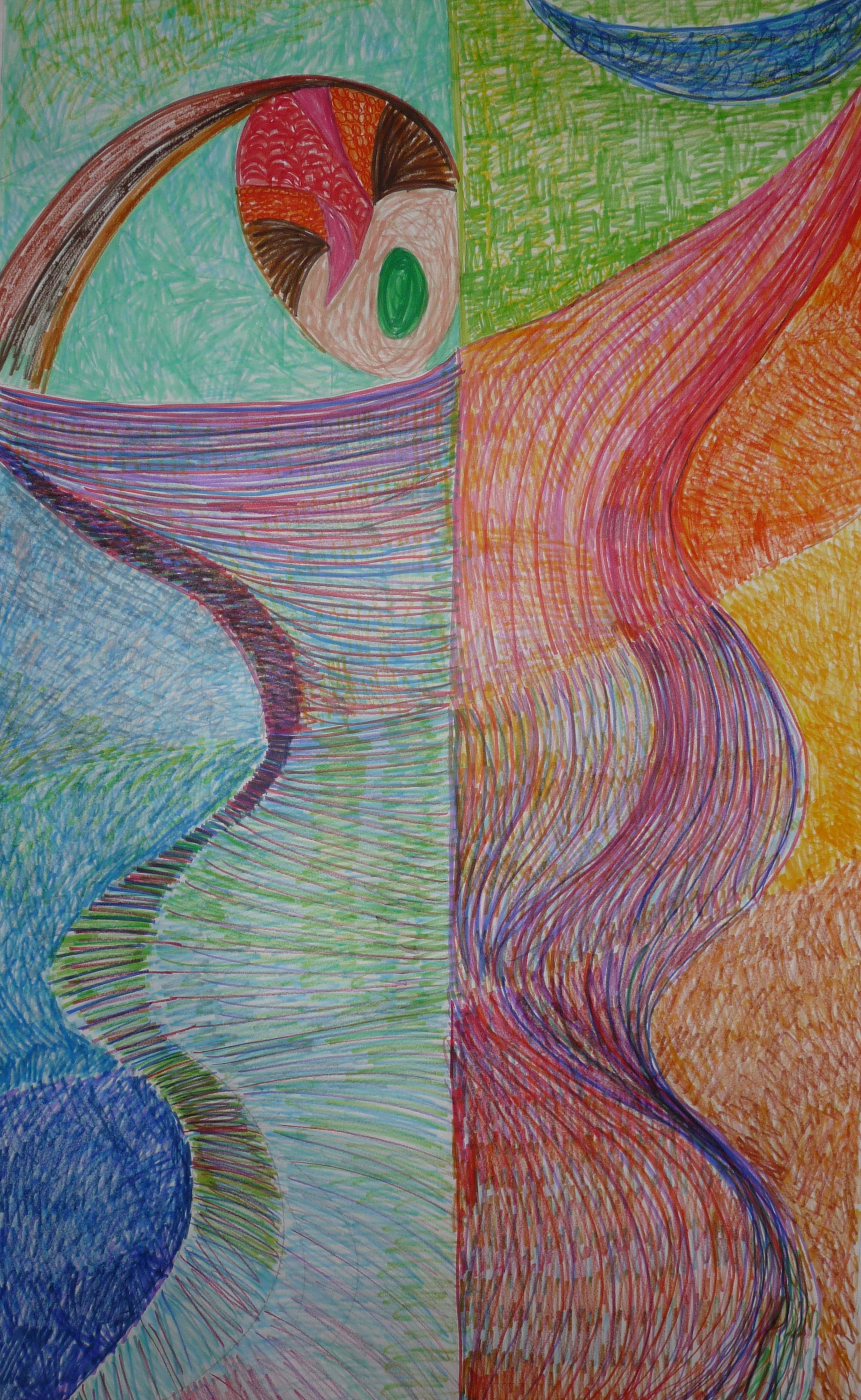
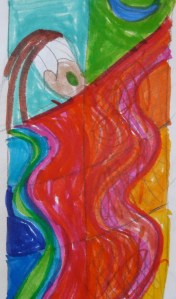
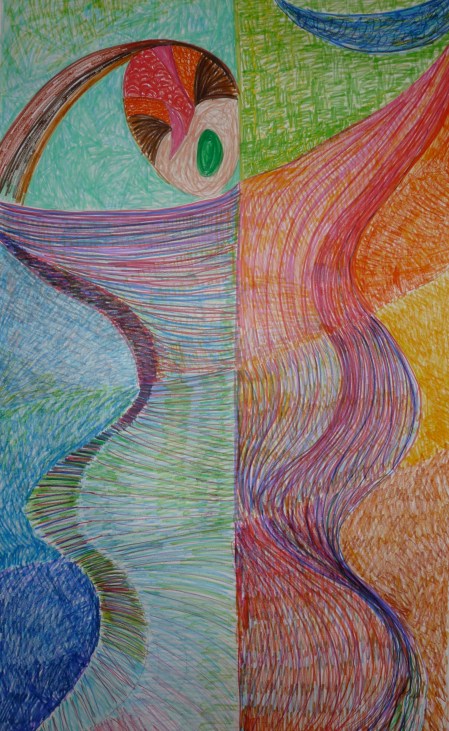
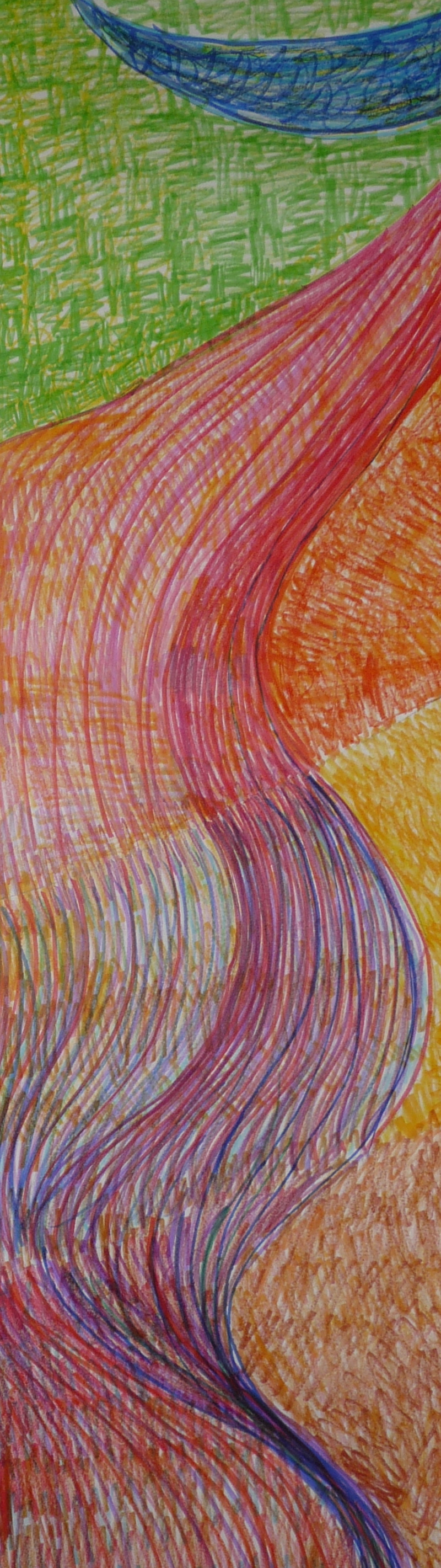
Another Wednesday arrives.  I tape a large sheet of butcher paper to the wall.  Use my new Crayola markers, in a pack of 50 colors with 12 scented ones.  I draw a large Guardian figure, fill of movement, energy, welcome.

I have kept most of my doodles and sketches out of sight after making them, feeling that it is too soon to let others see my play creations.  I leave this bold, bright, big guardian figure up on the wall of my living room.  I don’t want to curl the paper up and put it away – doing that would take some of the life and energy out of the process.

Since making her, I have found myself increasingly aware of how grateful I am for this time to creatively play.  It is essential to me.  Having lived without it, having found my way back, I know now how absolutely essential it is.  I don’t want to stop – in between times of play, I am preparing for when I can return, I long to continue, I look forward to what happens next. I love the improvisation. The relationship. With myself, with more than with myself.  With the process.  With living.

I find myself thinking: I must guard this, protect this, cherish this.  I must be the guardian of my own dance!
Guardian 1
Body of Play

February 2, 2011

Work and career are aspects of my life that I enjoy and take pride in.  However, I have always struggled to find a satisfying balance of work, family, and my need to create, to be an artist.  I won’t go into the long story of how hard this has been. Let’s just say blocking out time on my calendar to make art is guaranteed to result in everyone else in my family being home sick with the flu on the long awaited day (like last Wednesday) or the worst ice-storm in decades shutting down the entire city (like today).

So, here I am, on my designated day to stay home by myself to make art, sitting at the kitchen table with my laptop trying to write while my 13 year old daughter and her neighborhood friend are watching a movie a few feet away and my fiance is on the other computer in what was supposed to be my office.  (The house is small.  The living room is also the art making space.  My only option would be to retreat to the dimly lit bedroom.  But I do not have the kind of personality that can tune everyone else out and plunge wholeheartedly into my own art. I need solitude. I need to know that there won’t be kids circling around looking for something to eat and someone to cook it for them and there won’t be a man coming over to tell me his latest discovery on Ebay.)

Ever since my daughter was born, for the last 13 years of my life, this struggle to find non-negotiable time for solitude and creativity has been a problem I have never resolved.  I have tried various approaches. And have come to learn that there is no easy or clear-cut solution and there never will be.  This conflict between my need for creative solitude and my need for relationship and meaningful work will always exist.  I can’t sit around waiting for a more peaceful existence, with less to do and people who want nothing from me than that I go into a spacious studio and make art.  Instead I have to be determined and tenacious and make my creative life a priority that I commit to in whatever imperfect way is possible, every week.

Last fall, after a year of spiritual discernment in preparation for becoming an Associate with the Sisters of Providence, I wrote the following commitment statement:  I will protect at least 3 hours/week for playful creative expression in order to open to divine inspiration and experience Providence as a generous collaborative partner.  I will explore artistic play as a sacred process and as prayer which deepens and restores my relationship to self, others, world and Providence.

And I reorganized my life so that, every Wednesday, I have at least 3 hours while everyone else is away at work and school.  And as soon as Christmas vacation ended, I began doodling, sketching, experimenting, scribbling, showing up for my creative play dates!  The first Wednesday, I was feeling a bit under the weather, but I began and soon felt so grateful the stars had aligned and a beginning had been at last been made.  The next Wednesday, I picked up where I left off, getting not quite 3 hours in before taking my daughter to a dentist appointment, and doing another hour later in the week.  Then next Wednesday, I was physically exhausted, but again  showed up, with no expectations or demands of my time other than that I play with the art materials.  I have been doing my best to observe my process, to not demand finished products too soon, to see what imagination and play will lead to if I got out of the way and let things unfold. And despite recurring judgements that what I am doing is silly and worthless, I was beginning to feel some momentum and a feeling of hope.  I was looking forward to what the next week would bring.

And then the flu hit, and the ice storm.  During flu week, I managed to make a sketch I really want to continue with later.  I’d hoped to play with it today, but since we are all housebound in a suburban igloo today, I have decided instead to write this blog post.  I want and need to chronicle my creative efforts. And to share some of my reflections with others in this blog because I am sure there are other working-parent-artists out there like me searching for their own determination and tenacity to stay creative.

Here is what I’ve learned so far:

As an artist, I need to create a body of play. I have plenty of work in my life.  Even the thought of making a body of work shuts me down.

My sketches and doodles are most frequently of dancing woman, moving women, big, active, sensual women.  They surprise me.  A long time ago, I imagined myself making soft, peaceful, impressionist landscapes.  But I remember my mother looking at my elementary school drawings and saying that I did movement well.  I like to move. Movement is part of play.  I often feel crowded out by all the other demands of my life. No only do I need to make a visual body of play, I need to live in a body that is playful.

I like to stand up when I draw. I want to work on large paper.

The dance is ever changing.

There will be more time to create soon!  Yes, soon!


Upcoming Programs!!!

August 2, 2010

Please click on the orange links below to open brochures describing workshops starting at Enbarr Art Therapy studio this fall.

These workshops provide wonderful opportunities to slow down, relax, create, play and learn!

Beyond Burnout Prevention: Creative and Spiritual Renewal will meet October 2010 – May 2011 on the second Thursday of each month from 6:30 – 8:30 pm. Growth and self-care need time, quiet reflection, and ongoing encouragement to develop and thrive. This program allows participants to meet on a regular basis for an extended period of time to revitalize personally and professionally. BeyondBurnoutPrev

Fall Friday Workshops: Each workshop focuses on a different art form and provides a day long retreat once a month. This fall we will be exploring mosaics, mandalas, altered book journals, and poetry. To view the brochure about these workshops, click here: fallFridayworkshops2010 Also, longer descriptions of each Friday workshop can be found by clicking on the Friday Workshop page tab in the column on the right side of this blog home page.

Thanks for your interest and hope to see you soon at Enbarr Art Therapy Studio!

Moving Mandalas

July 7, 2010

birth

I recently taught an Introduction to Art Therapy undergraduate class at Herron School of Art and Design here in Indianapolis. Toward the end our summer session course, I drove downtown with a very loose plan in mind for what we were to do that day. I knew that I wanted the students (adept at visual art) to explore how movement, voice, poetry and story were also healing arts. I knew that, months ago, when creating the class syllabus, I had listed “mandala” as the in-class art activity. And I remembered other expressive therapy mandala-making that I had facilitated over the years. Each of these experiences had been very different, with a large element of spontaneity and unpredictability. And so, this day, I intentionally left my plans open, waiting to see what would unfold.

As I parked my car and walked to the art school, I was pleased that the morning was less humid than the days before, the kind of morning that made me want to stay outside. And so I realized the day need us to be outside as part of the class. And then a one of the poems I have recently learned by heart came to mind as a perfect way to start the day.

The school is located across the street from a large city park, and so when the students arrived, we walked over to a shady spot under a catalpa tree in the park and stood in a circle. I explained that I would say a poem and then we would stand in silence and be mindful of our breath, the sounds of nature and city, the sky, the earth, all that was present in and around us. Then I shared “Eagle Poem” by Joy Harjo, which starts: “To pray, you open your whole self to sky, to earth, to sun, to moon, to one whole voice that is you. And know that there is more that you can’t see, can’t hear, can’t know, except in languages that aren’t always sound but other circles of motion…”

childhood

After several quiet minutes, I invited the students to stay outside and to create mandalas, a circular drawing through which one’s current relationship to wholeness can be expressed. An hour later, we gathered inside the classroom and I asked the students to not talk about the experience, but instead, to arrange the mandalas into a circle, deciding as a group how to connect our individual creations to each other.

We then stood in a circle facing our mandalas. I asked the students to imagine a sound that belonged to their mandala, and then share that sound aloud. I went first because most people, including me, feel awkward and self-conscious making wordless sound in front of others. I tried to be relaxed, playful, silly, while doing my mandala’s “aaaahhh!!” sound. I asked the group to mirror back my sound, and then we went around the circle, each student choosing a sound and hearing it mirrored back by the group.

We then added a movement to the sound and mirrored this back for each other. We laughed as we went around the circle. My “aaaaaaaahhh!!” became longer and deeper as I lifted my arms in the air and lowered them as in a head-to-toe release.

The next step was to name the mandala with a word or short phrase, spoken aloud with the same movement and sound we’d already discovered for our mandala. I was surprised that the word “Now” flowed out as name for my mandala, but it felt good to say the word with the long, releasing breath of my “aaahhh!!”

By starting with sound and movement and limiting our use of language, my intention was to help us shift out of our habitual linear and rational way of thinking to our more ancient and mythic mind. And so, after naming the mandalas I asked the group to consider what story the mandala circle we surrounded might be telling us. Someone said that they saw “the elements” expressed within the mandalas. Another student said she saw “the stages of life,” and she pointed to each of the mandalas identifying the stage she saw in it: birth, childhood, adolescence, adulthood, death.

I sensed this idea resonating with the group and so invited the students to talk about each other’s mandalas, not explaining our own mandala’s original intention, but describing what we saw in them now in light of the “Stages of Life” story that was unfolding. We were surprised how much we saw in each other’s mandalas that was not placed their consciously, but came from some other source. For instance, in our collective story, my mandala had been identified as the stage of life “death.” While making it, I had begun by making arcing white shapes, and then felt the urge to meet these at a central point. Then I became immersed in creating a mirror world behind the white arcs, one day, one night. I felt I was responding the the feeling of newness in the fresh inviting morning. Yet, even while creating it, a fleeting awareness passed through me of a former client’s art made in response to a near-death experience. As we talked, I felt goosebumps for how this mandala that evoked for me letting go, release, and the name “Now” was somehow unconsciously an expression of the letting go and release of death.

adolescence

As we talked, we noted that in “Birth” we saw shapes and colors that reminded us of the current tragic oil spill in the Gulf, an ongoing disaster that had been on our minds and emerged in our art and discussions repeatedly in the previous weeks. Because we were looking at the mandalas as telling a community story and because the student who made the mandala had told us it’s name was “Catalyst,” I asked, “What if, the birth this mandala is expressing is not simply an individual human birth, but a birth for our culture. Perhaps the oil spill will incite us to leave behind old ways that are harming us and take on the creating of a culture that values ecologic sustainability. A cultural rebirth, a renaissance.”

adulthood

Responding to this question, the group looked again at the five mandalas as representations of the stages of growth that we will go through as a changing culture. We saw in “Childhood” a reconnection to nature, to knowing ourselves as part of the natural world. We saw in “Adolescence” a journey toward community that honors the feminine. We saw in “Adulthood” a maturing wisdom and treelike rooted presence. We saw in “Death” the passing away of the old era and the promise of a new day, a new mindful way of living.

To bring our story to a close, we went around the circle again saying our mandala’s name, with expressive sound and movement, this time being conscious of the deeper collective story that the mandalas had given us. The self-consciousness we felt at the beginning of the our sharing was no longer with us. Now we spoke and moved with a calm reverence, a quiet awe.

Before leaving for the rest of our busy days, I shared with the students that

death

I had had no expectations that what we did that day would unfold in the way it did, that I had planned only to set the stage, invite the creation of mandalas, and see what followed. I told them that I was surprised by the depth we reached. And yet not at all surprised. Given that we made mandalas in nature and community. In such a process, what else would we connect to if not the Circle of Life?  It wasn’t really that we stumbled upon something new and unexpected. Instead, we changed ourselves. We stepped out of the limited awareness that is our cultural habit, and entered the wholeness that is there always.

Inspired by “Saved by a Poem”

May 26, 2010

The First Rose of Summer

A friend recommended the book Saved by a Poem by Kim Rosen and I have been, not simply reading it, but incorporating its many rewarding practices, suggestions, questions, and meditations into my own poetry life.  The book describes the power of taking poems into your life and learning them by heart, “writing them into your bones” and speaking them aloud.  Being able to say poems, rather than reading them from written text, has been something I have known for some time that I needed to do.  But I have dreaded the process of memorizing and have doubted that, even if I did memorize a poem, it would stick in my brain for very long.  Rosen’s book gave me the courage to begin and renewed awareness of the power of spoken, felt, lived poetry.

I drive at least an hour or more every day for my work, and this summer, the highway I need to take regularly is under major reconstruction, so there are often traffic problems.  I decided, instead of feeling trapped by this undesired driveway, I would use the drive to learn poems.  I started with the CD that comes with the book, and then began to gather poems that have been favorites at various stages of my life since high school.  Using my Zoom H2 digital recorder, I recorded about 30 minutes of poetry, 12 “old favorite poems” by Mary Oliver, Rilke, Joy Harjo, others, and 12 of my own poetry.

Now, as I am driving, I am chanting lines from poems, embedding them in my heart.  I am driving more slowly without feeling stressed by the agressive drivers all around me. I am getting places early, because instead of leaving home at the very last  minute possible (or later than that), I look forward to the time with poetry that the drive brings so I leave home earlier and without regret.  Last week, rush hour afternoon traffic was worst than usual, with traffic backed up not just on the highway, but on all the suburban roads leading home.  I actually found myself glad that traffic was moving slowly because it gave me more time to learn the end of a new poem.  I arrived home feeling meditative, relaxed, without need to destress after the commute!

For anyone who loves poetry, I highly recommend this book.

Mosaics at Women’s Retreat

April 23, 2010

I am like a dish that is broken. (Psalm 31:12)

Faith Presbyterian Women's Mosaics

If God exists, He is there, in the small, cast off pieces, rough and random and no two alike.
(Stephanie Kallos, Broken for You, p. 367)


On Saturday, April 17th, I facilitated a mosaic retreat for women at Faith Presbyterian Church in northeast Indianapolis. We began with the following meditation, adapted from “Prayer of One Who Feels Broken Apart” in Praying Our Goodbyes by Joyce Rupp:

Take several broken pottery shards in your hands and hold them. Acknowledge present or past feelings and memories of time in which you were broken – broken hearted, broken by illness or loss. Hold these feelings and memories with compassion. Reflect on ways in which you have been closed, afraid of change, rigid, trying to defend yourself against further hurt, further experiences of being broken. And then imagine trusting your heart to break open, to surrender to new life, to let go of what no longer serves you so that some new life can be born within you. See the shards in your hands as the pieces of your former self, broken open through struggle, through growth and change. Imagine bringing these broken pieces of self to the mystery you know as the God whose son shares with us all of what it means to live in a breakable body, with a breakable heart. Ask God to help you piece these shards together into a new mosaic. Spend time in silent meditation, breathing and observing, and see if an image for this living mosaic might form in your imagination.

The mosaics above were created in response to this reflection.

Spring Art Meditations

April 15, 2010

The Green Man

I love spring!  And despite my longing for it all winter, I am still amazed each year by the surge of physical and creative energy that wakes in me as the days warm and the forest wildflowers bloom.

Yesterday and today I have been especially aware of a persistent feeling of deep contentment and a gratitude for ordinary moments (like watching the cat’s natural mindfulness as she sits on cushion by the open window).

Here are some suggestions of art meditations I have found to be “keepers” in my own personal practice. I will post other art meditations throughout the year, but these are ones that nurture the spirit of spring!

Fresh Air Painting:  Take a box of watercolors, some watercolor paper, a pencil, some brushes and water with you on a hike in the woods.  Look for as many kinds of spring ephemeral wildflowers as you can find.  Choose an area to sit and make loose, playful sketches of some of these flowers, and paint them.  Don’t be fussy or driven to make a “perfect” painting. Let the water, sunlight, and wind help you relax and play.  During times when you are waiting for washes of paint to dry, sit being aware of your breathing and practicing being present to the moment.

Begin a Creative Compost Pile:  On a regular basis, spend time doodling, experimenting, improvising, “fishing” for images and inspiration.  These experiments can be visual sketches, creative writing, song lyrics, etc., etc…!  Collect what you make, rejecting and discarding nothing. Trust that from your experiments the fertile soil of your creative garden will be replenished and something unexpected will begin to grow.

Resurrect a “Failed” Art Project – Return to something you created in the past year that was either left unfinished, seemed to come to a dead end, or was rejected by you for some reason or another.  Begin working with it again, transforming it subtly or even radically. Let it be like a seed, or like a bulb that has been dormant in the dark earth but from which now some unexpected new life can burst.  Do not worry about returning to the original intent of the project.  Let your present life add to and change the original piece.  Listen to what the original piece now communicates to you and then, through a new creative engagement with it, make an unexpected response.

New Spring Friday Workshops!

March 14, 2010

Hepatica, Fort Ben St. Park, Fall Creek Trail

Click on the link below to open a brochure describing this spring’s new Friday workshops, offering 6 CEUs as well as a day to reflect, create, renew!  In April, we will explore the influence of nature on creativity. In May we will combine meditation, poetry, and clay. And in June we will learn how simple boxes can become creative “altar” spaces.  Hope you can join us for one, two, or all three of these workshops! springFridayworkshops

Upcoming Workshop – March 19

March 10, 2010

Kriya - a dream image

March 19 Friday Workshop – DREAM TENDING THROUGH ART MAKING – In this workshop, we will explore the value of working with dreams in order to gain insight about physical, emotional, and spiritual needs.  We will learn a variety of techniques for tending dream images and meeting the healing wisdom within them.  Specific ways of integrating creative art expression into dream work will be practiced. Come prepared to explore imagery within one or more of your own recent dreams and to engage in group and community dream-tending activities!  ($150 – to register, post a comment here, or contact lizah2@lizahyatt.com.

Winter Dreams, Winter Poem

February 24, 2010

Bridge, Burr Oak Branches, St. Mary of the Woods College, February

I am not one of those people whose favorite season is winter. In fact, I start longing for spring before the Winter Solstice (the official beginning of the season) has occurred. Still, there are some things about winter that I do appreciate. It is my time for making large pots of soup, for reading novels under piles of blankets, for riding the stationary bike while catching up on movies from the video store. And every winter, after I have settled into the darkening and the feeling of refuge indoors, I have at least one significant dream.

A friend from college has asked that I post a poem she remembers me writing in February over two decades ago. I still have it, but don’t want to brave the cold garage to search through boxes of old writing to find it. Instead, I thought I would post a much more recent poem, and I have spent the morning looking for one with an encouraging reference to spring in it.

Instead, I have chosen a poem inspired by one of those winter dreams, and in choosing it, I am choosing also to enjoy the season of winter a little longer in its last few weeks this year!

WINTER SOLSTICE DREAMING

The trees have shed every leaf

and stand empty handed,

bare and unafraid

on this night of generous dark.

Snow is falling and dreams come,

no two ever the same,

these water jewels,

these numinous visits.

A man with one day to live

is throwing his abundant wealth into a waterfall,

laughing, never so alive.

The spend leaves of the profligate trees

are buried under treasure heaps of extravagant snow

and the dream man dies with dawn

but his gold remains –

this sudden exuberance of

giving in, surrendering to how it has to be –

this spending life on life,

spending all of it on living all of it.